


Introduction
Businesses increasingly rely on AI to analyze information, monitor operations, and make faster decisions. However, sending every piece of data to cloud servers can create delays, increase bandwidth usage, and raise data privacy concerns.
Edge AI offers another approach. It allows AI models to process information directly on local devices or nearby systems instead of depending entirely on cloud servers.
This makes AI useful in situations where quick responses and local data processing are important.
What Is Edge AI?
Edge AI combines artificial intelligence with edge computing. Instead of sending all data to a remote cloud server for analysis, an AI model runs on or near the device collecting that data.
These devices may include cameras, sensors, smartphones, industrial machines, and local servers.
For example, a smart security camera can identify unusual activity locally and send an alert without uploading continuous video footage to the cloud.
Cloud services can still be used for model updates, long-term storage, and advanced analysis. Edge AI simply reduces the need to send every task to the cloud.
How Does Edge AI Work?
Edge AI generally works through three main steps:
- Data Collection: Devices such as cameras, sensors, or machines collect information from their surroundings.
- Local AI Processing: An AI model installed on the device or a nearby edge system analyzes the information.
- Action or Response: The system generates an alert, recommendation, or automated response based on the result.
Only the necessary information may then be sent to the cloud for further processing or storage.
Understanding the Edge AI Processing Architecture
To understand how Edge AI works in a real business environment, it helps to look at its processing architecture.
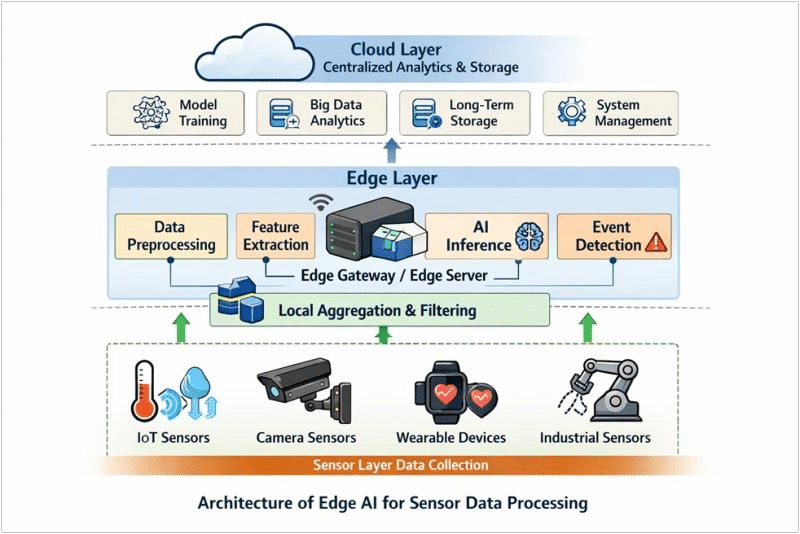
The architecture consists of three main layers:
1. Sensor Layer – Data Collection
The process starts with devices collecting information from their surroundings. These may include IoT sensors, security cameras, wearable devices, and industrial sensors.
For example, sensors in a manufacturing facility can collect machine temperature, vibration, and performance data.
2. Edge Layer – Local Data Processing
The collected data is sent to an edge gateway or edge server. This layer performs several important operations:
- Data Preprocessing: Cleans and prepares raw sensor data.
- Feature Extraction: Identifies useful patterns and relevant information.
- AI Inference: Runs an AI model locally to analyze the processed data.
- Event Detection: Identifies important events, such as unusual machine activity or potential equipment failures.
Local aggregation and filtering can also reduce unnecessary data before it is processed or transferred.
3. Cloud Layer – Centralized Analytics and Storage
The cloud layer supports activities that require centralized computing and long-term data management. It can handle model training, large-scale analytics, long-term storage, and system management.
The edge system can send selected results or relevant data to the cloud instead of continuously transferring all raw sensor information.
Together, these three layers allow businesses to process data locally while still benefiting from cloud-based analytics and management.
Key Benefits of Edge AI for Businesses
1. Faster Responses
Local processing reduces the time required to send data to a remote server and receive a response. This is useful for applications that need immediate decisions.
2. Reduced Cloud Dependency
Businesses can process selected AI tasks locally, reducing the amount of data transferred to cloud platforms.
3. Improved Data Privacy
Sensitive information can remain on local devices instead of being continuously transmitted elsewhere. However, local processing still requires proper device security and access controls.
4. Better Performance With Limited Connectivity
Edge AI can continue performing certain tasks even when internet connectivity is weak or temporarily unavailable.
5. More Efficient Operations
Businesses can use local AI processing to monitor equipment, detect issues, and respond to operational changes without relying on constant cloud communication.
Real-World Applications of Edge AI
Edge AI is useful across industries where data needs to be analyzed close to its source.
- Manufacturing: Monitor machines, identify unusual operating conditions, and detect product defects through computer vision.
- Healthcare: Support local analysis of medical device data and assist with monitoring in connected healthcare environments.
- Retail: Analyze store activity, monitor inventory, and understand customer movement using smart cameras and sensors.
- Transportation: Help vehicles and traffic systems process nearby information for faster responses.
- Smart Buildings: Monitor energy usage, access systems, and building equipment through connected devices.
For instance, a manufacturing facility can use cameras connected to an edge device to identify defective products while they move along a production line. This allows the system to flag issues without sending every video frame to a cloud platform.
Edge AI vs Cloud AI: What Is the Difference?
| Factor | Edge AI | Cloud AI |
|---|---|---|
| Processing | Local device or nearby system | Remote cloud servers |
| Response time | Often faster for local tasks | Depends on network communication |
| Internet dependency | Can work offline for supported tasks | Usually requires connectivity |
| Data handling | Can keep data locally | Often transfers data to the cloud |
| Computing resources | Limited by device capacity | Can access scalable cloud resources |
Neither approach is suitable for every situation. Edge AI works well when local processing and quick responses matter, while cloud AI is useful for large-scale computing, centralized data analysis, and model management.
Many businesses combine both approaches in a hybrid architecture.
What Should Businesses Consider Before Adopting Edge AI?
Before implementing Edge AI, businesses should evaluate a few important factors:
- Hardware Requirements: Choose devices with enough processing power and memory to run the required AI models.
- Model Optimization: AI models may need to be compressed or optimized for local hardware.
- Security: Protect devices, local data, and communication between edge systems and cloud platforms.
- Maintenance: Plan for software updates, model improvements, and device monitoring.
- Scalability: Consider how the solution will work when more devices or locations are added.
Starting with a specific use case, such as equipment monitoring or visual quality inspection, can help businesses understand the technical requirements before expanding the system.
How Mxpertz Can Help With Edge AI Development
Implementing Edge AI requires more than selecting an AI model. Businesses need the right combination of software, hardware integration, data processing, and deployment architecture.
Mxpertz helps businesses explore custom AI solutions, intelligent automation, and software integrations based on their operational requirements.
Whether you are planning an AI-powered monitoring system, a smart device application, or an intelligent business solution, our team can help turn your idea into a practical development plan.
Explore our AI and Robotics Development Services and AI, ML, and Automation Solutions.
Contact Mxpertz to discuss your Edge AI project.
Conclusion
Edge AI makes it possible to process information closer to where it is collected, reducing dependence on continuous cloud communication. It can help businesses improve response times, manage data more efficiently, and support intelligent operations.
For organizations working with connected devices, real-time monitoring, or sensitive data, Edge AI can be an important part of their AI strategy.


